




What Is CPL, CPC and ROAS in Digital Marketing? Complete Guide
Learn what CPL, CPC and ROAS mean in digital marketing, how each metric is calculated, why they matter, and how marketers use them to evaluate advertising campaigns.
What Is CPL, CPC and ROAS in Digital Marketing?
CPL, CPC and ROAS are important performance metrics used to evaluate digital marketing and advertising campaigns. They help marketers understand how much they are spending, how users interact with advertisements, how many leads are generated, and how advertising spend relates to revenue.
Understanding what CPL, CPC and ROAS mean in digital marketing is important for beginners because these metrics are commonly used in Google Ads, Meta Ads, performance marketing, lead generation, and eCommerce campaigns.
What Is CPC in Digital Marketing?
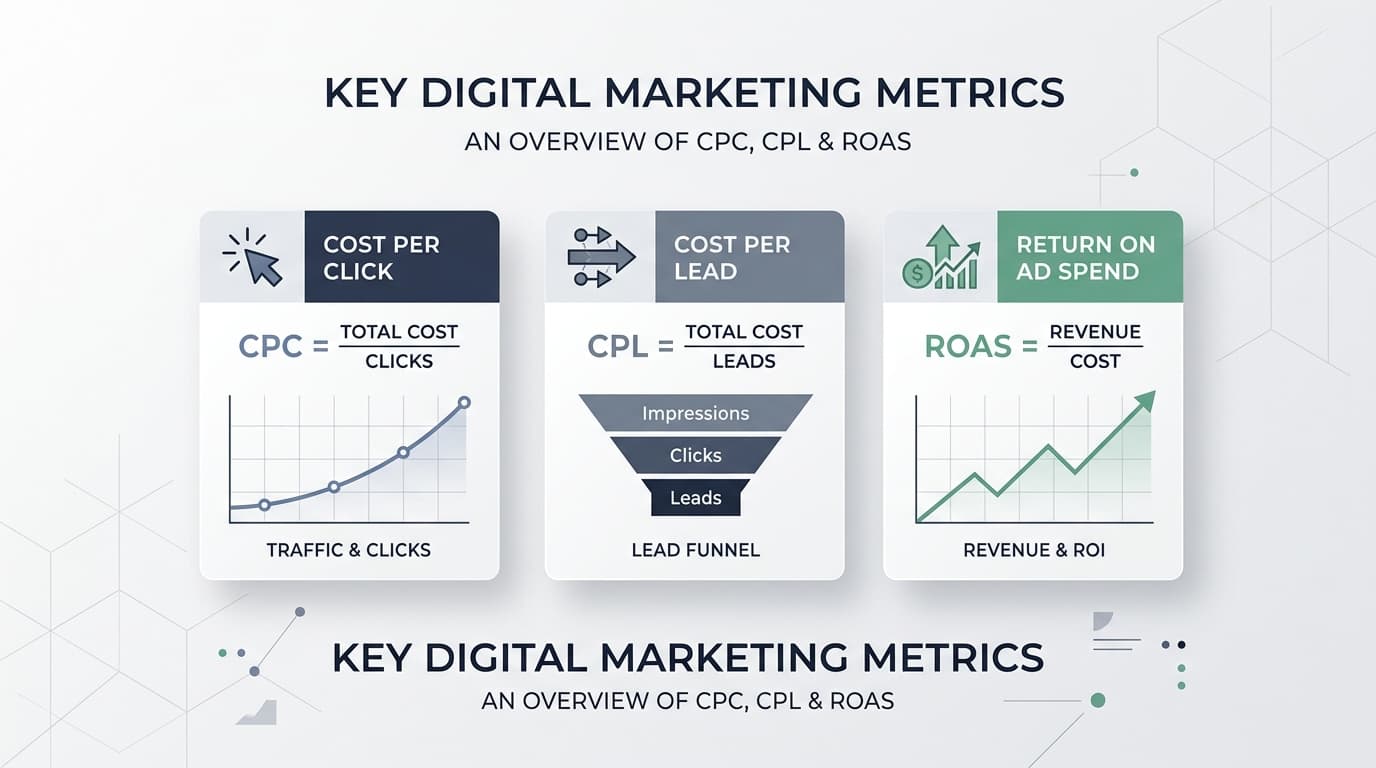
CPC stands for Cost Per Click. It represents the average amount spent for each click generated by an advertising campaign.
CPC is particularly useful when marketers want to understand how much they are paying to bring users from an advertisement to a website, landing page, or other destination.
CPC Formula
CPC = Total Advertising Cost ÷ Total Clicks
CPC Example
Suppose a campaign spends ₹1,000 and receives 200 clicks.
CPC = ₹1,000 ÷ 200 = ₹5 per click
This means the campaign generated clicks at an average cost of ₹5 each.
What Is CPL in Digital Marketing?
CPL stands for Cost Per Lead. It measures the average advertising cost required to generate one lead.
A lead could be a form submission, enquiry, registration, callback request, consultation request, or another action defined by the business.
CPL Formula
CPL = Total Advertising Cost ÷ Total Leads
CPL Example
Imagine a business spends ₹5,000 on an advertising campaign and receives 100 leads.
CPL = ₹5,000 ÷ 100 = ₹50 per lead
The campaign therefore generated leads at an average cost of ₹50 each.
What Is ROAS in Digital Marketing?
ROAS stands for Return on Ad Spend. It measures the revenue attributed to advertising compared with the amount spent on advertising.
ROAS is particularly useful for businesses that can accurately track revenue generated from their advertising campaigns.
ROAS Formula
ROAS = Attributed Revenue ÷ Advertising Spend
ROAS Example
If an eCommerce campaign spends ₹10,000 on advertising and generates ₹50,000 in attributed revenue:
ROAS = ₹50,000 ÷ ₹10,000 = 5
This can also be expressed as 5:1, meaning ₹5 of attributed revenue for every ₹1 spent on advertising.
ROAS should not automatically be interpreted as profit because other business costs, such as product costs, salaries, shipping, taxes, and operational expenses, may not be included.
CPL vs CPC vs ROAS
| Metric | Full Form | What It Measures | Common Use |
|---|---|---|---|
| CPC | Cost Per Click | Average cost of a click | Traffic and advertising analysis |
| CPL | Cost Per Lead | Average cost of a lead | Lead generation campaigns |
| ROAS | Return on Ad Spend | Attributed revenue compared with ad spend | Revenue-focused advertising campaigns |
Why Are CPC, CPL and ROAS Important?
Each metric answers a different marketing question.
- CPC: How much does the campaign spend to generate a click?
- CPL: How much does the campaign spend to generate a lead?
- ROAS: How much attributed revenue is generated relative to advertising spend?
Looking at these metrics together can provide a more complete picture of campaign performance than relying on one number alone.
How CPC and CPL Are Connected
CPC and CPL are related but they do not measure the same thing. A campaign can have a low CPC but a high CPL if many people click the advertisement without becoming leads.
For example, if an advertisement receives inexpensive clicks but the landing page generates very few enquiries, the campaign may produce a high cost per lead despite having a low CPC.
This is why marketers should analyze clicks, conversion rates, lead quality, and CPL together.
How CPL and ROAS Are Connected
CPL is useful for lead generation, while ROAS is generally more relevant when advertising revenue can be measured. A campaign may generate leads at a low CPL, but those leads may not necessarily generate high revenue.
Businesses should therefore consider lead quality and downstream sales when evaluating lead-generation campaigns.
Important Digital Marketing Metrics Alongside CPL, CPC and ROAS
Marketers often evaluate several metrics together rather than relying on CPL, CPC, or ROAS alone.
- CTR: Click-through rate measures the percentage of impressions that result in clicks.
- Conversion Rate: Measures the percentage of users who complete a desired action.
- CPA: Cost per acquisition measures the average cost of a specified acquisition or conversion.
- Impressions: Measures how many times an advertisement was displayed.
- Clicks: Measures the number of times users clicked an advertisement.
- Revenue: Measures tracked revenue associated with the campaign where applicable.
CPL, CPC and ROAS in Google Ads
Google Ads campaigns can use CPC, CPL, ROAS, conversion rate, CPA, and other metrics depending on the campaign objective and tracking configuration.
For example, a lead-generation campaign may focus heavily on conversions and CPL, while an eCommerce campaign may pay closer attention to conversion value and ROAS.
Marketers should select metrics according to the actual business objective instead of trying to optimize every metric at the same time.
CPL, CPC and ROAS in Meta Ads
Meta advertising campaigns can also be evaluated using metrics such as CPC, CPL, conversion rate, cost per result, and return-related metrics when revenue tracking is available.
The most useful metric depends on the campaign objective. A lead-generation campaign may prioritize lead volume, lead quality, and CPL, while an online sales campaign may focus more heavily on purchases and revenue-related measurements.
Example of CPL, CPC and ROAS Working Together
Consider a business that spends ₹20,000 on digital advertising.
The campaign receives 4,000 clicks and generates 200 leads.
- CPC = ₹20,000 ÷ 4,000 = ₹5
- CPL = ₹20,000 ÷ 200 = ₹100
If the campaign also generates ₹80,000 in attributed revenue, then:
ROAS = ₹80,000 ÷ ₹20,000 = 4
These three metrics provide different information about the same campaign. CPC describes the cost of traffic, CPL describes the cost of lead generation, and ROAS compares attributed revenue with advertising expenditure.
How to Improve CPC
Marketers can analyze targeting, keywords, advertisement relevance, competition, bidding strategies, and campaign structure when trying to improve click costs. However, reducing CPC should not be the only objective because inexpensive clicks are not necessarily valuable clicks.
How to Improve CPL
Improving CPL can involve refining audience targeting, improving advertisement relevance, testing creatives, improving landing pages, simplifying lead forms, and improving conversion tracking.
Lead quality should also be monitored because a lower CPL is not necessarily better if the resulting leads have little business value.
How to Improve ROAS
Improving ROAS can involve optimizing targeting, advertisements, product or service offers, landing pages, budgets, bidding strategies, and conversion tracking.
For eCommerce campaigns, product selection, pricing, margins, and customer behavior can also influence the overall business result.
CPL, CPC and ROAS for Beginners
Beginners should first understand what each metric measures rather than trying to memorize formulas alone. CPC focuses on clicks, CPL focuses on leads, and ROAS focuses on attributed revenue compared with advertising spend.
Practical campaign examples can make these metrics easier to understand because marketers can connect the formulas with real advertising data.
Learning Digital Marketing in Amritsar
Students learning digital marketing in Amritsar can benefit from understanding advertising metrics alongside SEO, social media marketing, content strategy, analytics, and conversion tracking.
When comparing a digital marketing institute in Amritsar, check whether the curriculum includes practical campaign analysis, Google Ads, Meta Ads, performance marketing, analytics, and reporting.
You can explore Techcadd's Digital Marketing Course in Amritsar to review its current course information and compare the curriculum with other available training options.
Performance Marketing Metrics
CPC, CPL and ROAS are particularly relevant to performance marketing because they help marketers evaluate measurable campaign outcomes.
Learners interested in paid advertising can develop practical skills in campaign setup, audience targeting, conversion tracking, reporting, and optimization.
Social Media Marketing and Advertising Metrics
Social media campaigns also use performance metrics to evaluate advertising results. Depending on the objective, marketers may track clicks, leads, conversions, cost per result, and revenue-related metrics.
Those researching a social media marketing course in Amritsar should look for practical training in campaign planning, audience targeting, advertising metrics, analytics, and reporting.
SEO and Digital Marketing Metrics
SEO uses a different set of primary performance indicators because organic search does not work like paid advertising. SEO professionals may examine organic clicks, impressions, rankings, organic traffic, conversions, and other website performance data.
If you are comparing the best SEO course in Amritsar, check whether the curriculum covers SEO analytics, Google Search Console, keyword research, on-page optimization, technical SEO, and performance measurement.
Frequently Asked Questions
What is CPC in digital marketing?
CPC stands for Cost Per Click. It measures the average advertising cost associated with generating a click.
What is CPL in digital marketing?
CPL stands for Cost Per Lead. It measures the average advertising cost required to generate a lead.
What is ROAS in digital marketing?
ROAS stands for Return on Ad Spend. It compares attributed revenue with advertising spend.
What is the difference between CPC and CPL?
CPC measures the cost of generating a click, while CPL measures the cost of generating a lead. A campaign can have a low CPC but a high CPL if clicks do not convert into leads effectively.
Is a low CPL always better?
Not necessarily. Lead quality and the eventual business value of those leads should also be considered.
Is a higher ROAS always better?
A higher ROAS indicates more attributed revenue relative to advertising spend, but ROAS alone does not represent overall profit because other business costs may not be included.
Which metrics should beginners learn first?
Beginners should understand CPC, CPL, CTR, conversion rate, CPA, and ROAS along with the business objective each metric is designed to measure.
Conclusion
CPC, CPL and ROAS are important digital marketing metrics, but they measure different parts of campaign performance. CPC measures the cost of clicks, CPL measures the cost of leads, and ROAS compares attributed revenue with advertising spend.
Understanding these metrics helps marketers analyze campaigns more effectively and make data-informed optimization decisions. For learners building digital marketing skills in Amritsar, practical knowledge of advertising metrics can complement training in Google Ads, social media marketing, SEO, analytics, and performance marketing.