Document Q&A Assistant
A RAG application over a real document set, with citations and a measured accuracy baseline.
- LangChain
- Hugging Face
- Claude API
4.7/5
Student rating
10
Structured modules
3+
Portfolio projects
12th pass
Entry requirement
TechCadd's Generative AI in Amritsar is aimed at students who have just finished 12th — whatever they have or have not done before. The early modules cover Foundations of AI & Generative AI, Python for AI and Prompt Engineering, so nothing later assumes knowledge you were never given. From there you take on Large Language Models in Practice and Retrieval-Augmented Generation. The second half is where it turns practical: you work in Python 3, ChatGPT, LangChain, Hugging Face, Claude API and Jupyter the way a team actually does, against briefs that carry a real deadline. Each module ends in something you have built and a trainer has reviewed, so you finish with a portfolio, a CV built around it and interview practice for Generative AI Associate, AI Application Developer and Prompt Engineer roles.
Not sure this is the right track?
A counselling call maps your background against the syllabus before you commit to anything. It takes about twenty minutes.
Book a counselling callAnyone can prompt a model; the employable skill is building something reliable on top of one, which means retrieval, guardrails and evaluation you can defend.
The generative ai programme runs across 1 year at TechCadd Amritsar and is built for students who have just finished school — no degree, no prior experience and no coding background assumed. Two hours a day, five days a week, in batches small enough that your work is looked at individually.
You can take it as a standalone career course, run it alongside a degree in the evening or weekend batch, or use it to fill a drop year with something a recruiter will actually read. Whichever route you take, the finish line is the same: a certificate, 3 reviewed projects and a portfolio you can talk through in an interview.
Foundations of AI & Generative AI is where the Generative AI track gets its footing. You work the concepts in the lab first, then carry them straight into the running project rather than leaving them as isolated exercises.
A reviewed piece of work demonstrating how generative ai differs from traditional ml and how large language models work.
Fundamentals, vocabulary and the first working artefacts. Nothing is assumed; everything is implemented.
Modules 01 – 04
The professional middle of the course. Real tooling, realistic inputs, and mentor review on every submission.
Modules 05 – 08
Depth, deployment and the capstone build that becomes the centre of your portfolio and your interview answers.
Modules 09 – 10
Finish this generative ai programme and you leave Amritsar with more than a certificate from your 12th year: a reviewed portfolio, an internship letter where the track applies, and a first role that is realistic rather than aspirational.
Every tool below is installed, configured and used by you during the course — not demonstrated on a slide. You leave able to set up your own environment from scratch.
8tools covered
There is no entrance test and no prerequisite degree. What the programme does assume is that you will show up for the full 1 year and do the project work.
The programme assumes nothing beyond a 12th pass and comfort with a computer. You start at the actual beginning of generative ai, and by month three you are working on a brief rather than an exercise.
Two hours a day fits either side of a college timetable. You graduate with a generative ai portfolio already built instead of starting one after your final semester.
An empty year reads badly on a CV. A certificate, 3 reviewed projects and an internship letter turn it into something you can explain in an interview.
Bring the business you already know and layer generative ai onto it. Students in this group usually apply the first two modules inside their own shop or unit before the course has ended.
Job titles vary by company, but the underlying expectations do not. Each destination below maps to work you will have already done during the programme.
Each project is reviewed individually, and the review notes go into your portfolio documentation.
A RAG application over a real document set, with citations and a measured accuracy baseline.
A tool-using agent that classifies incoming queries and drafts replies for human approval.
A scored test suite that catches quality regressions before they reach a user.
A certificate answers what you can do today. This is the honest answer to what generative ai looks like three to five years out, and why the fundamentals this course spends real time on are what carry you there.
The 1 year programme is built around the part that is genuinely in your hands — and you leave holding all of it.
A reviewed portfolio, an industry-recognised certificate and a fundamentals-first foundation you can keep building on. Markets move, as they always have; that foundation is exactly what lets you move with them as AI and data work around you keeps shifting.
With so many institutes and online platforms offering AI courses, it's fair to ask what makes a program worth your time and investment. Techcadd's Generative AI Training course in Amritsar focuses on practical skills and real-world applications rather than theory alone.
You won't simply watch AI demonstrations and take notes. Concepts are reinforced through practical exercises, assignments, prompt-building activities, AI tool usage, and real-world projects. By the end of the course, you'll have practical experience that you can discuss and demonstrate rather than only a certificate showing that you attended training.
The course follows a logical progression, beginning with Generative AI fundamentals and gradually moving toward prompt engineering, AI tools, content creation, automation, and practical projects. Concepts are introduced step by step so beginners can understand how different AI technologies and tools are used.
Generative AI is increasingly being used for content creation, productivity, research, marketing, automation, software development, and business workflows. The program focuses on practical applications that learners can understand and apply in real-world situations.
One of the most important parts of working effectively with Generative AI is knowing how to communicate with AI systems. Students learn how to structure prompts, provide context, define requirements, refine outputs, and improve results through better instructions.
Learning new AI technologies can involve confusion and experimentation. Techcadd's trainers provide support to help students understand concepts, work through practical exercises, and clarify their doubts.
Whether you're a student managing college classes or a working professional managing job responsibilities, flexible batch options can make it easier to continue learning.
Generative AI skills can complement careers in technology, marketing, content creation, business, education, and other digital fields. The training focuses on helping students understand how to present and apply their AI skills professionally.
Being based in Amritsar means students can learn locally without needing to relocate to another city. Learners from nearby areas such as Tarn Taran, Batala, and Ajnala can also access training in Amritsar.
Collected from students who completed the generative ai programme at the Amritsar campus, across morning, evening and weekend batches. Hover a card to slow the row right down and read it.
4.7
out of 5
178 verified reviews from Amritsar students
I joined the Generative AI batch with almost no background, and what made the difference was that foundations of ai & generative ai was taught by building rather than by slides. By the third week I was debugging my own code instead of copying someone else's.
The project reviews are the real value. My support triage agent was picked apart line by line, and those notes are exactly what I ended up talking through in the interview that got me a ai application developer offer.
Weekend batches meant I kept my job through the whole 1 year. Anything I missed got re-explained without fuss, and lab access outside batch hours was never a problem.
ChatGPT and the rest of the stack were set up on day one, so no week went into environment issues. Batches are small enough that a doubt gets answered the same day instead of piling up.
I had tried learning generative ai on my own twice and stalled both times. A fixed batch in Amritsar, a mentor who checks your work and a deadline on every module is the only reason I finished.
Placement support was not just a line on the brochure — resume and portfolio review, two mock interviews with people who do the job, and a referral into one of the hiring drives.
The syllabus is current. We worked in Python 3 rather than the older tooling most generative ai syllabi around here still teach, and that came up directly in my first interview.
The balance of theory to lab time is about right: enough to understand why something works, then straight into building. I left with 3 projects I can demo, not just a certificate.
If something here is not covered, the Amritsar desk will answer it directly — no call-back queue.
Yes. The entry requirement is 12th pass, any stream, and there is no entrance test. Admissions run through the year rather than in a single intake window, so you can start in the gap between your result and college admissions closing.
Provision it, containerise it, automate the deploy — then keep it alive when something fails at 2am.
1 yearStatistics, wrangling, modelling and visual storytelling — the full path from a messy CSV to a decision someone acts on.
1 yearClassical ML first, neural networks second, with vision and language projects trained on hardware you have access to.
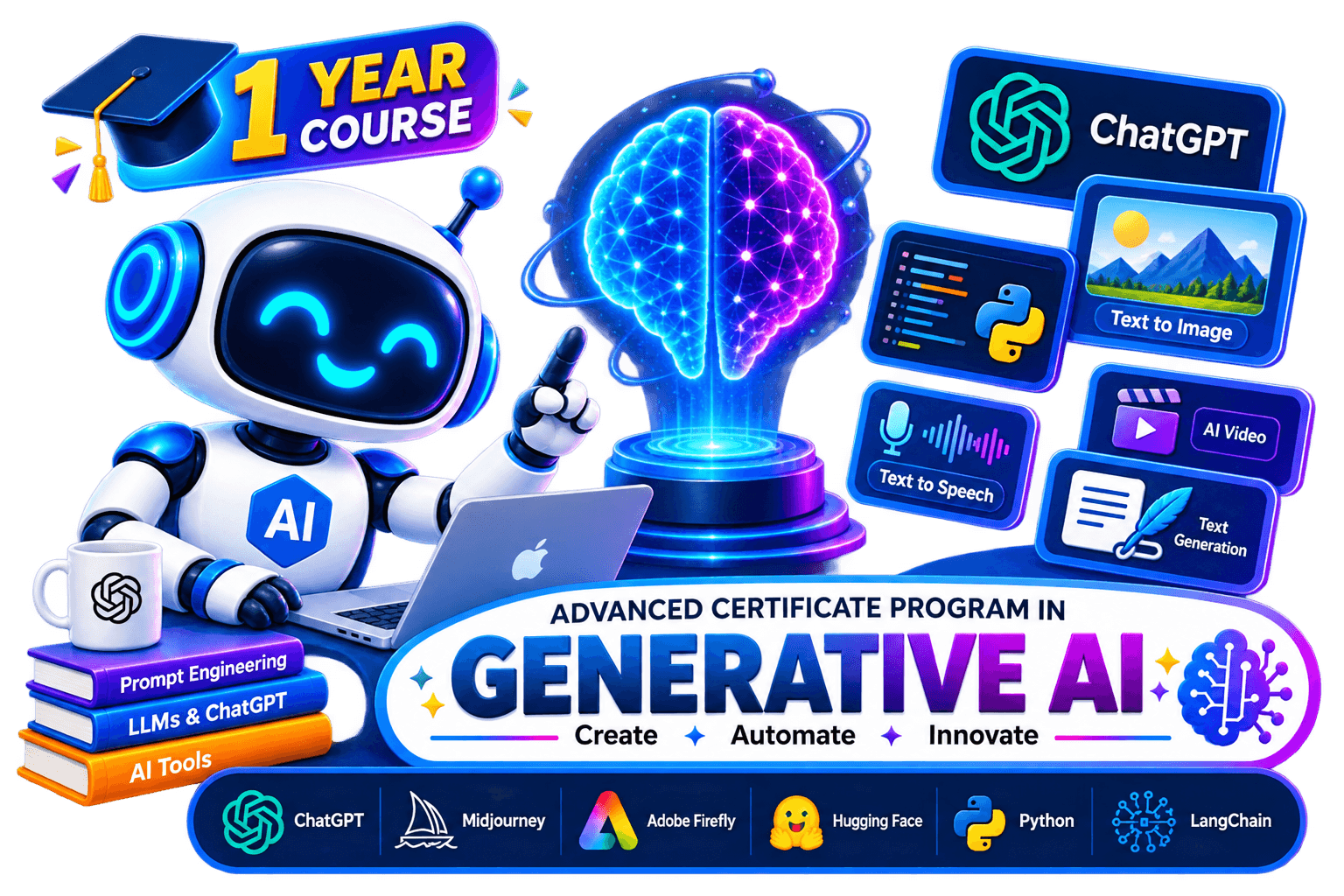
1 yearLearn how to use Generative AI strategically — with practical training, real projects, mentor support, and career-focused guidance at Techcadd, Amritsar.
About the Generative AI course · 1 year
Book a free demo class and see the lab before you decide.