

Hardened Server Build
A Linux server taken from default install to a documented hardened baseline, with before/after scans.
- Wireshark
- Metasploit
- Burp Suite

4.7/5
Student rating
9
Structured modules
3+
Portfolio projects
12th pass
Entry requirement
TechCadd's Cybersecurity in Amritsar is aimed at students who have just finished 12th — whatever they have or have not done before. The early modules cover Networking & Security Fundamentals, Operating System & System Security and Ethical Hacking & Penetration Testing, so nothing later assumes knowledge you were never given. From there you take on Web Application Security and Network Security & Threat Detection. The second half is where it turns practical: you work in Kali Linux, Nmap, Wireshark, Metasploit, Burp Suite and Nessus the way a team actually does, against briefs that carry a real deadline. Each module ends in something you have built and a trainer has reviewed, so you finish with a portfolio, a CV built around it and interview practice for SOC Analyst (L1), IT Security Trainee and Network Support Executive roles.
Not sure this is the right track?
A counselling call maps your background against the syllabus before you commit to anything. It takes about twenty minutes.
Book a counselling callSecurity work is defensive first: you cannot protect a system you do not understand, so the course builds the network and Linux base before any tooling appears.
The cybersecurity programme runs across 6 months at TechCadd Amritsar and is built for students who have just finished school — no degree, no prior experience and no coding background assumed. Two hours a day, five days a week, in batches small enough that your work is looked at individually.
You can take it as a standalone career course, run it alongside a degree in the evening or weekend batch, or use it to fill a drop year with something a recruiter will actually read. Whichever route you take, the finish line is the same: a certificate, 3 reviewed projects and a portfolio you can talk through in an interview.
Networking & Security Fundamentals is where the Cybersecurity track gets its footing. You work the concepts in the lab first, then carry them straight into the running project rather than leaving them as isolated exercises.
A reviewed piece of work demonstrating ip addressing and tcp/ip, dns and http/https.
Fundamentals, vocabulary and the first working artefacts. Nothing is assumed; everything is implemented.
Modules 01 – 03
The professional middle of the course. Real tooling, realistic inputs, and mentor review on every submission.
Modules 04 – 06
Depth, deployment and the capstone build that becomes the centre of your portfolio and your interview answers.
Modules 07 – 09
Finish this cybersecurity programme and you leave Amritsar with more than a certificate from your 12th year: a reviewed portfolio, an internship letter where the track applies, and a first role that is realistic rather than aspirational.
Every tool below is installed, configured and used by you during the course — not demonstrated on a slide. You leave able to set up your own environment from scratch.
8tools covered
There is no entrance test and no prerequisite degree. What the programme does assume is that you will show up for the full 6 months and do the project work.
The programme assumes nothing beyond a 12th pass and comfort with a computer. You start at the actual beginning of cybersecurity, and by month three you are working on a brief rather than an exercise.
Two hours a day fits either side of a college timetable. You graduate with a cybersecurity portfolio already built instead of starting one after your final semester.
An empty year reads badly on a CV. A certificate, 3 reviewed projects and an internship letter turn it into something you can explain in an interview.
Bring the business you already know and layer cybersecurity onto it. Students in this group usually apply the first two modules inside their own shop or unit before the course has ended.
Job titles vary by company, but the underlying expectations do not. Each destination below maps to work you will have already done during the programme.
Each project is reviewed individually, and the review notes go into your portfolio documentation.
A Linux server taken from default install to a documented hardened baseline, with before/after scans.
A packet capture analysed to identify and explain suspicious activity.
A full response write-up for a lab breach: timeline, impact, containment and prevention.
A certificate answers what you can do today. This is the honest answer to what cybersecurity looks like three to five years out, and why the fundamentals this course spends real time on are what carry you there.
The 6 months programme is built around the part that is genuinely in your hands — and you leave holding all of it.
A reviewed portfolio, an industry-recognised certificate and a fundamentals-first foundation you can keep building on. Markets move, as they always have; that foundation is exactly what lets you move with them as cyber and cloud work around you keeps shifting.
Choosing the right cyber security program isn't just about learning concepts — it's about building skills that translate directly into employability. Here's why Techcadd's Cyber Security Training stands out for students and professionals in Amritsar.
Cyber security can't be mastered by reading slides. Techcadd's curriculum is built around hands-on labs where you actively perform vulnerability scans, simulate network attacks in controlled environments, and practice defense techniques used by real SOC teams. You'll work with industry-standard tools rather than only studying them on paper, so what you learn maps directly to what employers expect you to already know.
The program is designed as a progressive journey — starting with networking basics, operating systems, and security fundamentals, then advancing into ethical hacking, penetration testing, web application security, and digital forensics. This structure ensures you're never thrown into advanced material without the foundation to understand it, which is a common gap in self-taught or purely online learning.
Learning from someone who has worked on actual security incidents is very different from learning from someone who has only studied the theory. Techcadd's trainers bring real-world case studies, current threat trends, and practical war stories into the classroom — helping you understand not just "how" a technique works, but "why" and "when" it's used in the field.
For students and working professionals in Amritsar, this means quality cyber security education without the cost and disruption of relocating to a metro city. You get the same depth of training, delivered locally, with a schedule that can work around college or job commitments.
Technical skill alone doesn't guarantee a job — positioning matters too. Techcadd supports learners with resume building, interview preparation, and placement guidance tailored to cyber security roles, helping bridge the gap between "trained" and "hired."
Unlike many IT skills that risk automation or market saturation, cyber security demand continues to outpace supply globally and in India. Enrolling now positions you ahead of the curve in a field where organizations are actively struggling to find qualified talent — meaning stronger job security and salary potential over time.
Completing a structured, practical program adds a credible credential to your resume — something that stands out to recruiters compared to purely self-taught or unverified online course completions.
Together, these factors make Techcadd's Cyber Security Training a strong choice for anyone serious about building a real, sustainable career in security — not just collecting certificates.
Collected from students who completed the cybersecurity programme at the Amritsar campus, across morning, evening and weekend batches. Hover a card to slow the row right down and read it.
4.7
out of 5
11 verified reviews from Amritsar students
I joined Techcadd's cyber security course after finishing my BCA from a college near Amritsar. The hands-on labs made all the difference — we actually used Kali Linux and Burp Suite instead of just reading about them. Got placed as a Junior Security Analyst within 2 months of completing the course.
Being from a non-technical background (I did my graduation in commerce), I was nervous about joining a cyber security course. The trainers at Techcadd Amritsar started from the basics and built up gradually. Six months later, I actually understand how ethical hacking works — something I never thought I'd say.
Good course overall. The networking fundamentals section was a bit slow for me since I already had IT experience, but the penetration testing and web app security modules were excellent. Would recommend to anyone switching careers into security.
What I liked most was the small batch size. Our trainer actually knew each student's name and progress, unlike the crowded batches I heard about at other institutes in Amritsar. Learned Nmap, Wireshark, and Metasploit properly with real practice time.
I was working as a network admin and wanted to move into a security role. Techcadd's course gave me exactly the practical exposure I needed — especially the digital forensics module. Cleared an interview for a SOC Analyst role right after finishing.
Solid curriculum, very career-focused. The trainers shared real incident examples which made the theory click faster. Only wish the course covered cloud security in more depth, but overall a great learning experience in Amritsar.
As a 12th pass student, I had zero background in IT. Techcadd took me from not knowing what a firewall was to confidently performing vulnerability scans. The step-by-step approach really works for beginners.
Techcadd's placement support was genuinely helpful — resume review, mock interviews, the works. Combined with the practical labs, I felt properly prepared when I started applying for security analyst roles in Amritsar and Chandigarh.
Good hands-on exposure to tools like Metasploit and Nessus. The trainer had real industry experience which showed in how he explained attack scenarios. Batch timing was flexible enough to manage alongside my final year college classes.
I researched multiple institutes in Amritsar before choosing Techcadd, and I'm glad I did. The course is genuinely practical — not just PowerPoint slides. The digital forensics and web application security sections were my favorites.
Switched from a mechanical engineering background into cyber security through this course. Wasn't easy at first, but the trainers were patient and the lab sessions helped everything make sense. Now working as a trainee penetration tester.
If something here is not covered, the Amritsar desk will answer it directly — no call-back queue.
Yes. The entry requirement is 12th pass, any stream, and there is no entrance test. Admissions run through the year rather than in a single intake window, so you can start in the gap between your result and college admissions closing.
Search, social, paid media and analytics run as one measurable system — on a live client account from the second month, not a demo dashboard.
6 monthsFrom your first line of code to a deployed application — the entry point for anyone heading towards data, AI or backend work.
6 monthsModels built on data you have had to clean yourself, evaluated honestly, and written up the way a hiring manager expects to read them.
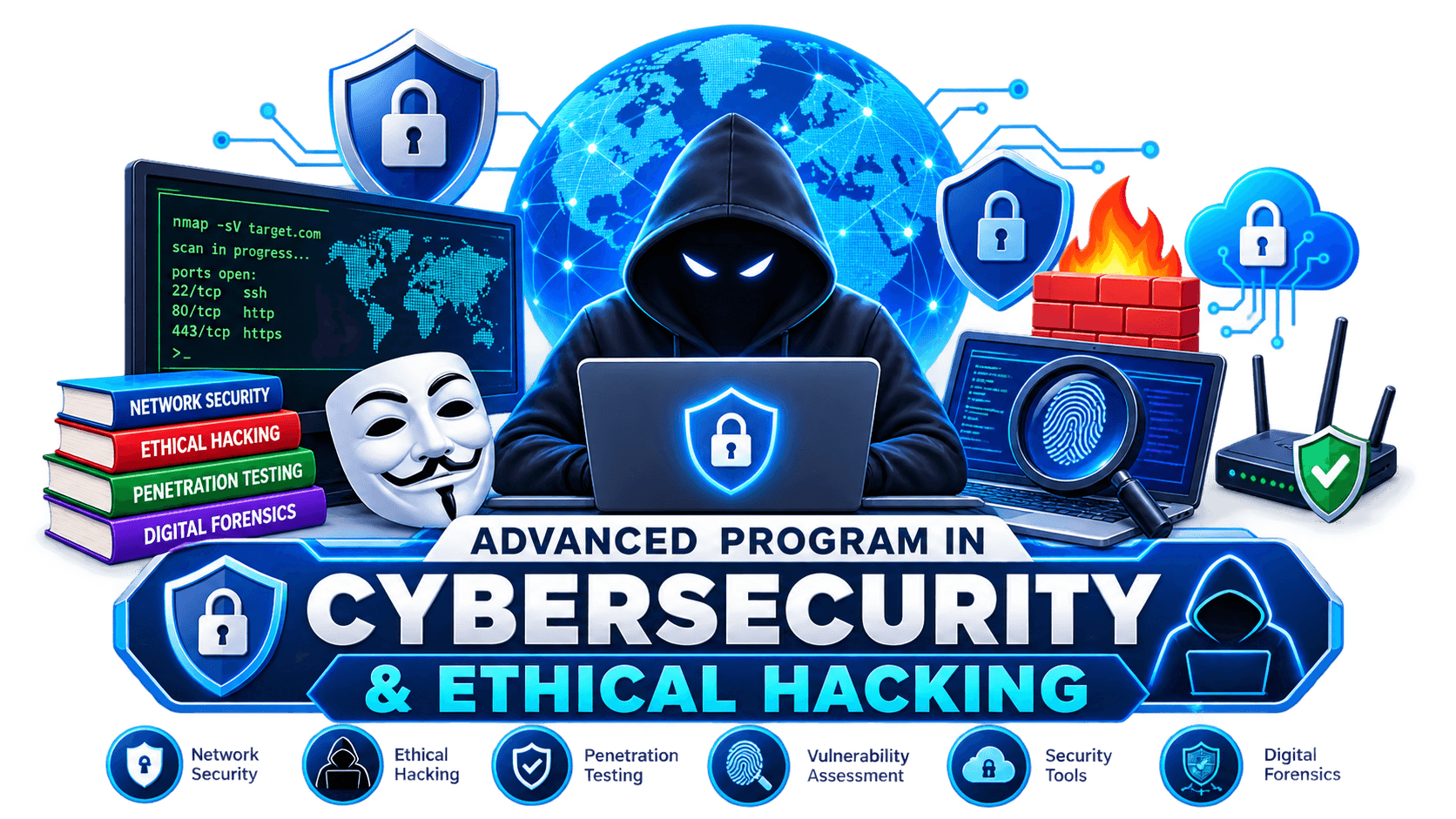
6 monthsGet hands-on training in ethical hacking, network security, and penetration testing from industry-experienced trainers. Limited seats per batch to ensure personal attention.
About the Cybersecurity course · 6 months
Book a free demo class and see the lab before you decide.