


How Does Google Ads Work? Complete Beginner's Guide
Learn how Google Ads works, including campaign setup, keywords, bidding, ad auctions, targeting, costs, conversions, and optimization with practical examples for beginners.
How Does Google Ads Work?
Google Ads is an online advertising platform that allows businesses to promote products and services across Google's advertising network. Advertisers create campaigns, choose relevant targeting, set budgets and bids, create advertisements, and direct users to relevant landing pages.
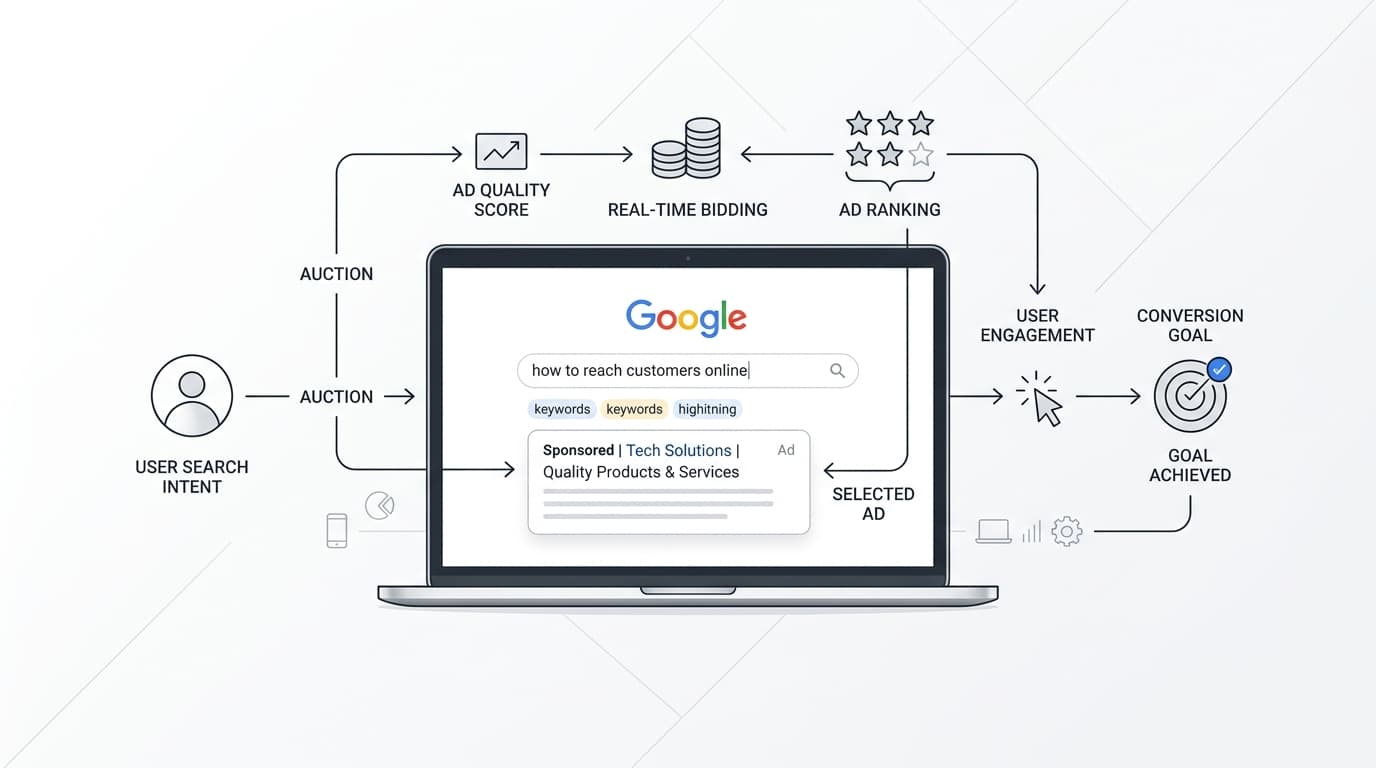
When someone searches for a product or service on Google, an advertising auction can determine which eligible ads may appear and where they are shown. Advertisers generally pay when users interact with their advertisements according to the campaign's bidding and billing model.
Understanding how Google Ads works is important for digital marketers because the platform combines keyword targeting, audience signals, bidding, ad quality, budgets, landing pages, conversion tracking, and continuous optimization.
What Is Google Ads?
Google Ads is Google's advertising platform for businesses that want to reach potential customers through paid digital advertising. Depending on the campaign type, advertisements can appear on Google Search and across other Google advertising properties and partner placements.
Businesses can use Google Ads for different objectives, including generating website traffic, leads, sales, app-related actions, or awareness, depending on the campaign type and setup.
How Google Ads Works Step by Step
- Choose a campaign objective.
- Select an appropriate campaign type.
- Define the target audience or search targeting.
- Research relevant keywords where applicable.
- Create advertisements.
- Select a relevant landing page.
- Set a budget and bidding strategy.
- Configure campaign targeting and settings.
- Launch the campaign.
- Track results and conversions.
- Optimize the campaign using performance data.
How Does the Google Ads Auction Work?
Google Ads does not simply display advertisements based on which advertiser offers the highest bid. When an eligible search occurs, an ad auction determines which ads can appear and their position.
The auction considers factors related to the advertiser's bid, ad quality, relevance, expected impact of ad assets, search context, and other signals. This means improving ad relevance and the overall user experience can be important alongside managing bids.
What Are Google Ads Keywords?
Keywords are words or phrases that advertisers can use to help connect search campaigns with relevant searches. Marketers research keywords based on what potential customers may search for when looking for a product, service, or solution.
For example, a training institute targeting students in Amritsar might research searches related to digital marketing courses, SEO training, Google Ads training, or other relevant educational services.
Keyword Match Types
Google Ads provides different keyword matching options that help advertisers control how closely user searches should relate to their selected keywords. Marketers should choose match types according to their campaign goals and monitor actual search terms to improve targeting.
What Is Google Ads Bidding?
Bidding determines how an advertiser competes for available advertising opportunities. Google Ads offers different bidding approaches depending on campaign type and objective.
Some strategies can focus on clicks, conversions, conversion value, or other campaign goals. The appropriate bidding strategy depends on the objective, available conversion data, budget, campaign type, and business requirements.
How Much Does Google Ads Cost?
There is no single fixed price for Google Ads. Advertising costs can vary depending on factors such as competition, keywords, audience, industry, location, campaign settings, bidding strategy, ad quality, and demand.
Advertisers can set campaign budgets, but the actual cost and performance can vary according to the campaign configuration and auction environment.
For this reason, businesses should evaluate Google Ads using metrics such as cost per click, cost per lead, conversion rate, and conversion value rather than assuming that every keyword has the same advertising cost.
What Is a Google Ads Campaign?
A campaign is a structured part of a Google Ads account where advertisers define important settings such as campaign type, budget, targeting, bidding, locations, and other parameters.
Campaigns can be organized according to different business goals, products, services, locations, or audiences.
What Are Google Ads Ad Groups?
Ad groups help organize advertisements and related targeting within a campaign. In search advertising, keywords and advertisements within an ad group should generally be closely related so that the message shown to users matches their search intent.
For example, an education business could separate campaigns or ad groups according to different course categories instead of placing every keyword and advertisement into one group.
What Is a Google Ads Landing Page?
A landing page is the webpage users reach after clicking an advertisement. A relevant landing page should clearly match the advertisement and the user's search intent.
For example, an advertisement for a digital marketing course should ideally direct users to a relevant course page rather than an unrelated homepage.
Why Is Conversion Tracking Important in Google Ads?
Conversion tracking helps advertisers understand whether their campaigns are generating valuable actions. Depending on the business, a conversion might be a form submission, phone call, purchase, registration, booking, or another defined action.
Accurate conversion tracking gives marketers data that can be used to evaluate campaigns and make optimization decisions.
Important Google Ads Metrics
- Impressions: The number of times an advertisement is shown.
- Clicks: The number of times users click an advertisement.
- CTR: The percentage of impressions that result in clicks.
- CPC: The average cost associated with a click.
- Conversions: The number of tracked desired actions.
- Conversion Rate: The percentage of relevant interactions that result in conversions.
- CPL: The average cost associated with generating a lead.
- CPA: The average cost associated with a specified acquisition or conversion.
- ROAS: A metric comparing attributed revenue with advertising spend when revenue tracking is applicable.
Google Ads Example
Suppose a student searches for a digital marketing course in Amritsar. A training institute that has created a relevant Google Ads campaign may be eligible to show an advertisement for its course.
If the student clicks the advertisement, they can be taken to a relevant course landing page. If the student submits an enquiry form, the business can record that action as a conversion when conversion tracking is correctly configured.
The marketer can then analyze the campaign's clicks, enquiries, costs, conversion rate, and other data to determine what should be optimized.
Google Ads vs SEO
Google Ads and SEO can both help businesses appear when users search for relevant terms, but they work differently.
| Google Ads | SEO |
|---|---|
| Paid advertising | Organic search optimization |
| Can provide visibility after campaigns are approved and launched | Usually requires time to build organic visibility |
| Requires advertising budget | Does not require payment to a search engine for each organic click |
| Campaigns can be controlled through budgets and targeting | Focuses on website, content, technical and organic search improvements |
Businesses can use both approaches depending on their goals, budget, competition, timeline, and available resources.
Google Ads for Local Businesses in Amritsar
Google Ads can be useful for businesses that want to reach customers in specific locations. A business serving Amritsar can configure its campaigns around relevant locations and services.
Local businesses can use paid search to promote services such as education, healthcare, hospitality, retail, real estate, professional services, and other offerings, depending on their target audience and campaign objectives.
How to Learn Google Ads
- Learn digital advertising fundamentals.
- Understand search intent and keyword research.
- Learn Google Ads account and campaign structure.
- Study bidding and budgeting concepts.
- Learn how to write relevant advertisements.
- Understand landing page optimization.
- Learn conversion tracking.
- Study campaign metrics.
- Practice campaign planning using sample projects.
- Learn how to analyze and optimize campaign performance.
Google Ads Skills for Digital Marketing Beginners
Beginners should learn more than simply creating an advertisement. A practical Google Ads skill set includes keyword research, search intent, campaign structure, ad copywriting, targeting, bidding, budget management, landing pages, conversion tracking, analytics, and optimization.
Combining Google Ads knowledge with SEO, social media marketing, content, and analytics can provide a broader digital marketing foundation.
Choosing a Digital Marketing Institute in Amritsar
If you are comparing a digital marketing institute in Amritsar, check whether Google Ads training includes practical campaign planning, keyword research, ad creation, targeting, conversion tracking, analytics, and optimization.
Techcadd Amritsar is one local training option learners can research. You can explore the Digital Marketing Course in Amritsar and compare the current curriculum, practical projects, tools, and learning format with other programs.
Google Ads and Social Media Marketing
Google Ads and social media advertising are different paid advertising channels. Google Ads can help businesses reach users through search and other Google advertising placements, while social advertising can reach users based on platform-specific targeting and campaign objectives.
Students researching a social media marketing course in Amritsar should check whether the program covers paid social advertising, audience targeting, campaign planning, creative testing, analytics, and reporting.
Google Ads and SEO Training
Google Ads and SEO can complement each other. Paid campaigns can provide measurable advertising data, while SEO focuses on building organic search visibility.
Students who want to specialize in organic search can compare curriculum, practical assignments, local SEO, keyword research, technical SEO, and content optimization when looking for the best SEO course in Amritsar.
Google Ads Career Opportunities
Google Ads skills can be useful for roles such as PPC Executive, Google Ads Specialist, Paid Media Specialist, Performance Marketing Executive, and Digital Marketing Executive.
Employers may also expect knowledge of analytics, conversion tracking, landing pages, campaign optimization, communication, and reporting.
Frequently Asked Questions
How does Google Ads work?
Google Ads works through an advertising auction. Advertisers create campaigns, select targeting, set budgets and bidding strategies, create advertisements, and compete for eligible advertising opportunities. Google uses auction-related factors to determine which ads can appear and their positions.
How much does Google Ads cost?
There is no fixed Google Ads price. Costs vary according to factors such as competition, keywords, location, targeting, bidding, campaign settings, and demand.
Do I need a website to use Google Ads?
Many Google Ads campaigns direct users to a website or landing page, although the exact requirements depend on the campaign type and advertising objective.
Is Google Ads better than SEO?
Google Ads and SEO have different purposes. Google Ads provides paid advertising opportunities, while SEO focuses on organic search visibility. Businesses may use either or both depending on their objectives.
Is Google Ads difficult to learn?
The basic concepts can be learned by beginners, but effective campaign management requires practice with keywords, targeting, bidding, conversion tracking, analytics, and optimization.
Can Google Ads be used for local businesses?
Yes. Businesses can use location-related campaign settings and relevant targeting to reach audiences in specific service areas, subject to Google's advertising options and policies.
Which is the best digital marketing institute in Amritsar for Google Ads?
Compare institutes based on Google Ads syllabus, practical campaign work, keyword research, conversion tracking, analytics, trainers, and project-based learning rather than relying only on promotional claims.
Conclusion
Understanding how Google Ads works requires learning more than advertisement creation. The process involves campaign objectives, keywords, targeting, bidding, budgets, ad relevance, landing pages, conversion tracking, analytics, and continuous optimization.
For beginners in Amritsar, practical Google Ads training can be combined with SEO, social media marketing, analytics, and other digital marketing skills. When selecting a training program, compare the curriculum and practical work carefully to find an option that matches your learning goals.